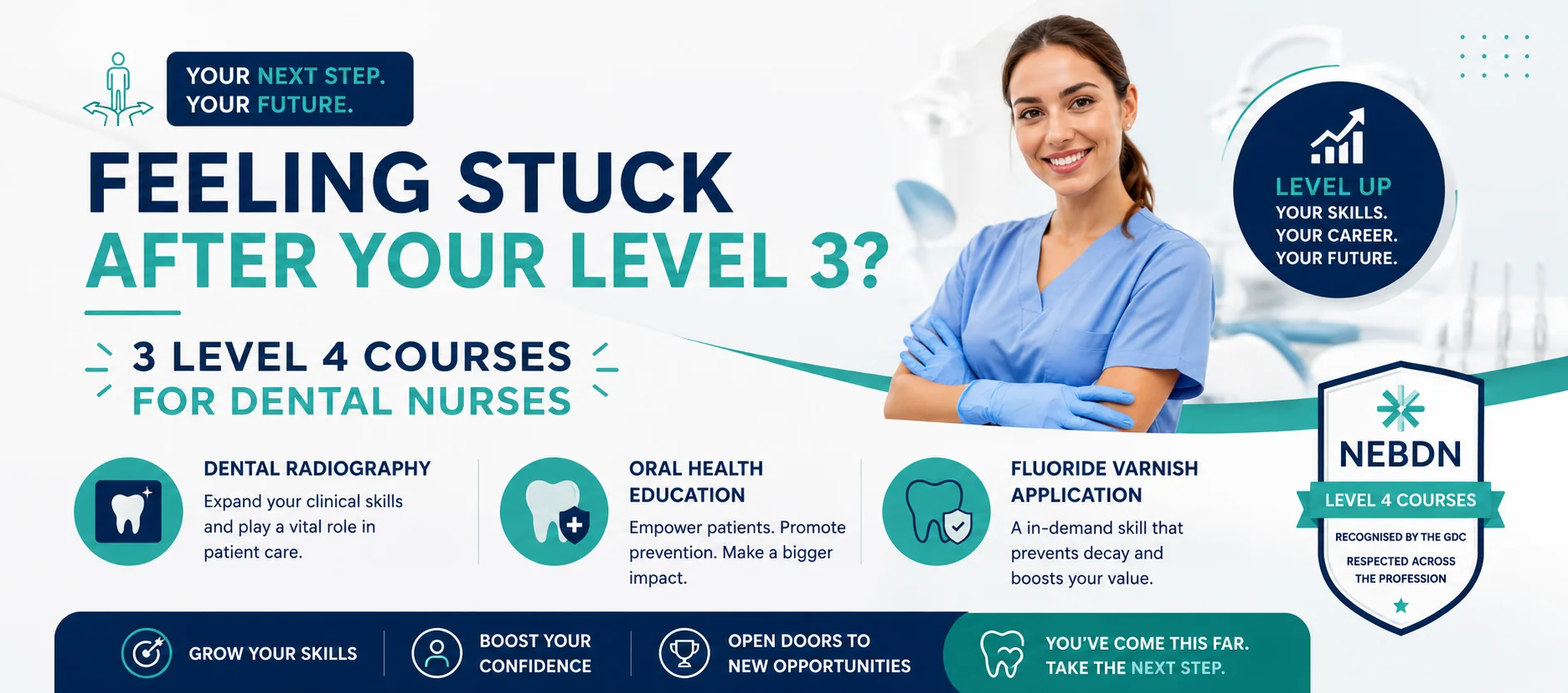
Feeling Stuck After Your Level 3? Here Are 3 Ways to Upgrade Your Dental Nursing Career
You've studied hard, completed your Level 3 Diploma, registered with the GDC, and settled into practice life. But lately, you might be hitting a bit of a wall. The initial excitement of qualifying has faded, and you're finding yourself stuck in a loop of standard chairside mixing, suctioning, and decontamination cycles.
If you're feeling a bit stagnant, you are completely normal. Many dental nurses hit this exact plateau. The good news: your Level 3 isn't the finish line, it's just the foundation.
Upgrading your skills with a Level 4 post-registration qualification is one of the fastest ways to break out of a professional rut, build a stronger CV, and bring genuine clinical variety back into your working week. Instead of just assisting, these courses let you step forward and take a more active role in patient care, always within your professional scope of practice.
Top 3 Level 4 Courses to Advance Your Career
- Certificate in Dental Radiography
If you want to become a genuinely indispensable member of your clinical team, this is the course to take. Once qualified and competent, you can act as an IR(ME)R operator under a dentist's prescription, meaning you're able to take intra-oral and extra-oral radiographs yourself rather than waiting for the clinician to do it.
- Why: It changes your day-to-day workflow. You'll be stepping out of a purely assisting role to capture diagnostic images yourself, helping treatment planning move faster.
- Career impact: Radiography is one of the most requested skills on employer job listings. Practices value radiography-qualified nurses because it saves the dentist time and keeps appointments moving.
- Entry requirements: Current GDC (or Irish Dental Council) registration, a supportive employer who can supervise your Electronic Record of Competence, and a valid First Aid or Basic Life Support certificate.
- Assessment: A work-based Electronic Record of Competence plus a 90-minute written exam (45 multiple-choice questions and 30 extended matching questions), sat in March or September.
Learn more: Certificate in Dental Radiography
- Certificate in Oral Health Education
Do you love the patient-facing side of the job but wish you could do more than make small talk? This qualification builds you into an oral health educator. You'll develop the communication techniques and behaviour-change frameworks needed to deliver oral health advice confidently and run dedicated preventative sessions within your practice.
- Why: You gain real day-to-day patient ownership. You'll be advising specific groups, such as children, pregnant patients, or those with additional needs, on diet, brushing technique, and disease prevention, working within your professional scope of practice rather than simply repeating a leaflet's worth of advice.
- Career impact: It opens doors to community dental health roles, school outreach programmes, and dedicated preventative clinics within both private and NHS practices.
- Entry requirements: Current GDC/IDC registration, a supportive employer to supervise your Electronic Record of Competence, and a valid First Aid or BLS certificate.
- Assessment: The same structure as Radiography, an Electronic Record of Competence plus a 90-minute written exam (MCQ and extended matching questions).
Learn more: Certificate in Oral Health Education
- Certificate in Fluoride Varnish Application
If you want a highly clinical, hands-on skill you can pick up relatively quickly, this is an excellent choice. This certificate qualifies you to apply fluoride varnish directly to patients' teeth on prescription, or as part of a structured community dental health programme.
- Why: It introduces genuine hands-on clinical variety into your week and is a strong confidence builder, bridging the gap between assisting and delivering active preventative treatment.
- Career impact: Assessment is entirely work-based, through a Record of Competence, with no written exam. It pairs naturally with Oral Health Education to build a rounded preventative care specialism.
- Entry requirements: This is the one exception worth knowing before you commit: unlike the other two, you'll need a minimum of six months' post-registration experience, up-to-date CPD and a current PDP, and an existing clinical supervisor with adequate patient access, on top of current GDC registration. It's not something you can enrol in the week you qualify.
- Assessment: A Record of Competence only, no written exam, typically six weeks of guided online learning followed by up to three months to complete the workplace portfolio.
Learn more: Certificate in Fluoride Varnish Application
How to Get Started
|
Course |
Key Focus |
Best For |
Typical Assessment |
Minimum Experience |
|
Dental Radiography |
X-rays, radiation physics and safety |
Technical, fast-paced environments |
Exam + Record of Competence |
None specified beyond GDC registration |
|
Oral Health Education |
Communication, patient motivation and diet |
Patient-facing, preventative roles |
Exam + Record of Competence |
None specified beyond GDC registration |
|
Fluoride Varnish |
Clinical preventative application |
Quick upskilling, hands-on treatment |
Record of Competence only, no exam |
6 months post-registration |
Pro tip: Talk to your practice manager before enrolling. Because Level 4 courses require a workplace supervisor to sign off your practical portfolio, many practices are willing to help fund the course or give you dedicated clinic time to complete it, since the resulting skill benefits the whole team.
Frequently Asked Questions
What is a Level 4 dental nursing qualification? It's a post-registration certificate you can take once you're already a GDC-registered dental nurse, building a specific clinical or educational skill on top of your Level 3 Diploma.
Do I need experience before starting a Level 4 course? It depends on the course. Dental Radiography and Oral Health Education generally require current GDC registration and a supportive employer, with no fixed minimum post-registration period stated. Fluoride Varnish Application specifically requires at least six months' post-registration experience plus an existing clinical supervisor.
Which Level 4 course is quickest to complete? Fluoride Varnish Application tends to be the fastest to finish since there's no written exam, just guided online learning followed by a workplace Record of Competence. Radiography and Oral Health Education both include a 90-minute written exam sat in fixed exam windows (March and September).
Can I do more than one Level 4 course? Yes. Many dental nurses combine Oral Health Education with Fluoride Varnish Application to build a preventative care specialism, or add Radiography for a more diagnostics-focused skill set.
Will my employer pay for a Level 4 course? Some will, particularly if the qualification adds a service the practice can offer patients. It's worth raising directly with your practice manager, since the practical portfolio requires their support regardless.
Don't Let Your Career Stall on Autopilot
Level 4 courses give you the clinical variety and professional standing that make dental nursing a genuine long-term career, not just a day job. Whichever route you choose, the first step is checking you meet the entry requirements and talking to your practice about supervision and support.
Browse dental nurse and post-registration roles on Dental Job Online